The “Shy Run” Robot
How Tiangong Omni (天工 Omni) won the 400 m small-group final in 45.66 seconds — not by looking human, but by discovering a running strategy its engineers never designed.

The Robot That Covered Its Face
At the 2026 WHRG, the most talked-about machine was not the fastest. It was the one that ran as if it were hiding.
At the 2026 World Humanoid Robot Games in Beijing, one of the most talked-about robots was not the fastest machine on the track. It was the one that ran as if it were trying to hide its face.
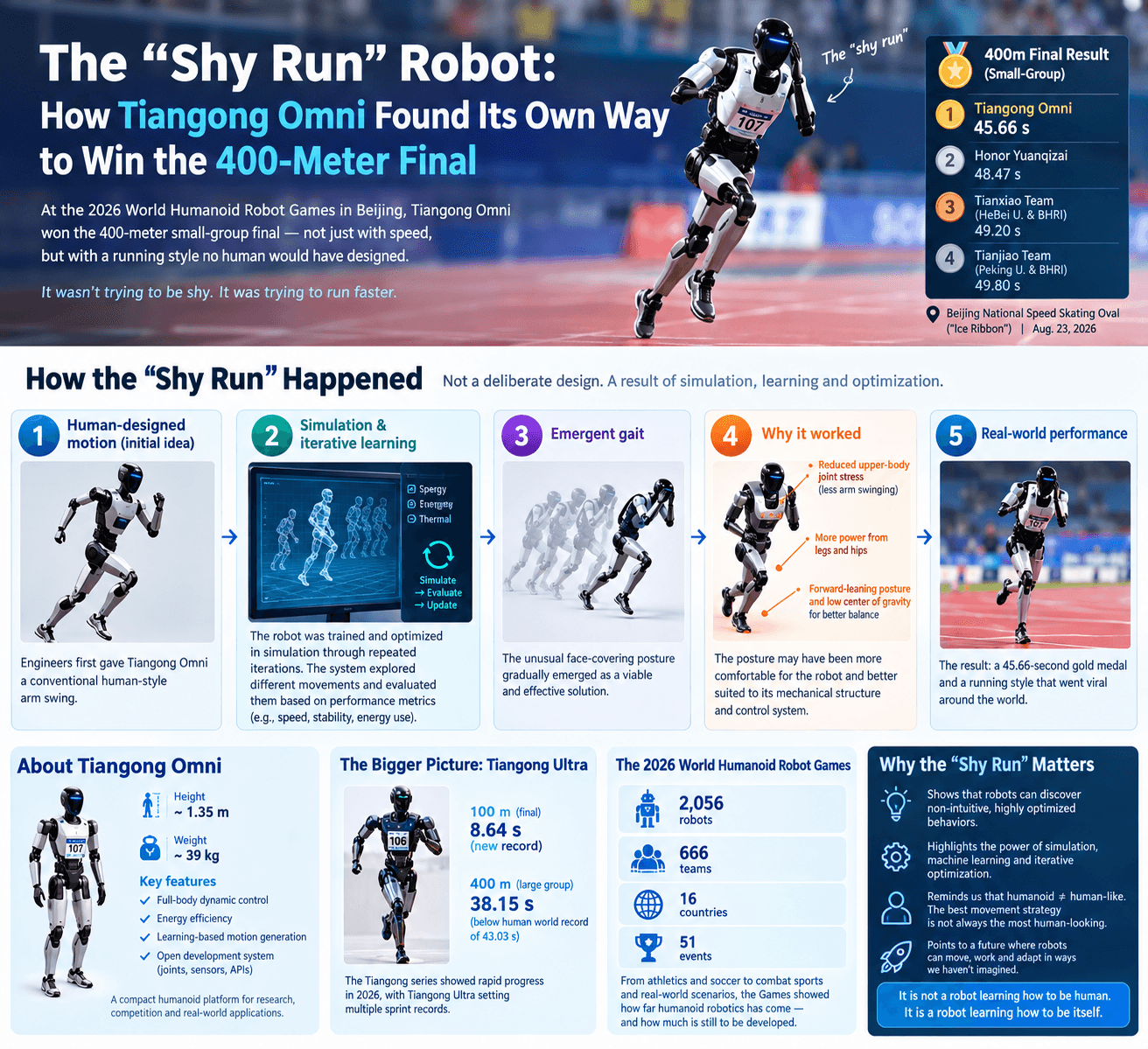
On August 23, Tiangong Omni (天工 Omni) won the 400-meter small-group final in 45.66 seconds, beating Honor’s Yuanqizai (元气仔), which finished second in 48.47 seconds. But the result was only part of the story.
What made Tiangong Omni go viral was its unusual running style: its arms stayed raised close to its face while its body leaned sharply forward, creating a gait that looked remarkably like a person running while covering their face.
Chinese viewers quickly nicknamed it the “face-covering run,” the “shy run,” or the “bashful run.”
The joke, however, hides a more interesting engineering story. Nobody taught Tiangong Omni to run that way. The posture emerged through simulation and repeated motion optimization.
In other words: the robot was not trying to look human.
It was trying to run faster.
Why Does Tiangong Omni Run Like That?
According to the team, the original design was a normal arm-swinging run. Then simulation took over.
According to Han Gang (韩刚), a motion-control algorithm expert at the Beijing Humanoid Robot Innovation Center and the leader of the Tiangong Omni 400-meter development team, the original design was much closer to conventional human running.
The team initially gave the robot a normal arm-swinging running pattern.
But Tiangong Omni was then trained and optimized in simulation through repeated iterations. As the system explored different movements, the unusual arm position gradually emerged as a viable solution. Han explained that the robot seemed to find the face-covering posture more comfortable than conventional arm swinging.
That distinction is important.
- The engineers did not deliberately design a "cute" running style.
- They did not ask the robot to imitate a child or a human athlete.
- The posture emerged from the optimization process.
One of the more interesting aspects of the Tiangong Omni story: the robot did not need to reproduce human biomechanics simply because it has a humanoid body. It could search for a movement strategy that worked better for its own mechanical structure.
A Different Body Needs a Different Running Strategy
Humans evolved for one biomechanical system. Humanoid robots are built for another.
Human runners have evolved — and trained — for a particular biomechanical system. Arm swing, hip rotation, leg motion and torso movement work together to maintain balance and generate propulsion.
A humanoid robot does not necessarily have the same constraints.
- Motors, joints, battery, body mass distribution, cooling system and control architecture are fundamentally different from those of a human athlete.
- Copying human movement is therefore not always the optimal solution.
- For Tiangong Omni, keeping the arms relatively stable while allowing the torso and hips to contribute more may have offered a better trade-off for its particular hardware and control system.
Chinese reports have also highlighted the robot’s low center of gravity and its highly forward-leaning posture, particularly when negotiating the track.
The Robot Did Not "Learn to Be Shy"
The nickname is useful. But it exists entirely in our eyes, not inside the machine.
The nickname “shy run” is useful for explaining the phenomenon, but it should not be taken literally.
Tiangong Omni is not displaying embarrassment, personality or emotion.
The “shyness” exists entirely in the eyes of human observers.
Humans naturally interpret familiar body language. When they see a humanoid robot running with its hands near its face, they immediately associate the posture with hiding, shyness or embarrassment. That anthropomorphic interpretation is precisely what made the footage so shareable.
But underneath the viral moment is a much less human process: optimization. The robot was searching for a movement pattern that could satisfy its performance objective.
Simulation Changes the Way Robots Learn to Move
The shift from hand-crafted trajectories to objective-driven learning is quietly rewriting how robots walk and run.
The Tiangong Omni example illustrates a broader shift in robotics.
For decades, robotic movement was often created by engineers explicitly defining trajectories, joint angles and motion sequences.
Instead of specifying every detail of how a robot should move, engineers can define objectives and constraints, then allow learning algorithms to explore a much larger range of possible behaviors.
- The resulting movement may not look elegant to humans.
- It may not even resemble the motion an engineer would have designed manually.
- But if it satisfies the objective — running faster, maintaining balance, reducing energy consumption or surviving a demanding maneuver — it can become a useful solution.
Tiangong Omni’s “shy run” is a particularly easy-to-understand example of this principle.
The robot did not discover a new emotion. It discovered a new movement strategy.
Tiangong Omni Is Built for More Than Robot Racing
The 400 m race is a controlled stress test — not the platform's final destination.
Tiangong Omni is a relatively compact humanoid, standing about 1.35 meters tall and weighing approximately 39 kilograms. The platform is designed for applications including work in confined spaces, emergency response, research and education, and future household services. It also supports an open development system that provides access to joints, sensors, system functions and motion-control APIs.
That makes the 400-meter race more than a publicity stunt.
Competitive robotics provides a controlled environment in which developers can push locomotion systems toward their limits.
A robot that can run quickly for 400 meters still has a long way to go before it can reliably work in a home, factory or public environment. But the underlying capabilities are related.
The better a humanoid robot becomes at controlling its body dynamically, the more capable it can potentially become when walking, climbing stairs, carrying objects or recovering from unexpected disturbances.
Part of a Much Faster Tiangong Platform
Omni's 45.66 s sits inside a platform that keeps rewriting humanoid athletics records.
Tiangong Omni’s performance also needs to be viewed within the rapid development of the broader Tiangong humanoid platform.
At the same Games, the larger Tiangong Ultra (天工 Ultra) achieved a series of remarkable athletics results. It won the large-group 400-meter final in 38.15 seconds — well below Wayde van Niekerk’s human world record of 43.03 seconds.
Tiangong Ultra also set the headline-grabbing 100-meter record during the Games, ultimately reaching 8.64 seconds according to reporting on the event.
These results illustrate how quickly humanoid locomotion is progressing in a highly controlled competitive environment.
The second World Humanoid Robot Games brought together 2,056 robots from 666 teams representing 16 countries, competing across 51 events. Beyond athletics, the Games included soccer, combat sports and real-world scenario competitions covering areas such as household tasks, industrial operations and emergency response.
The event therefore provides a useful snapshot of where humanoid robotics stands today: increasingly capable at specific physical tasks, while still facing significant challenges in general-purpose autonomy and reliability.
The Real Significance of the "Shy Run"
The most interesting thing is not that it looked funny. It is that the robot found a solution humans might not have chosen.
The most interesting thing about Tiangong Omni’s viral run is not that it looked funny.
It is that the robot found a solution that humans might not have chosen.
For a humanoid robot, looking human and moving optimally are not necessarily the same thing. That distinction could become increasingly important as embodied AI develops.
- If robots are trained primarily to imitate humans, their behavior will naturally remain constrained by human examples.
- But if learning systems are allowed to explore the physical possibilities of their own bodies, they may eventually develop movement strategies that look strange, inefficient or even impossible from a human perspective.
- Those strategies can, however, work extremely well for machines.
Tiangong Omni’s “shy run” is a small but visually striking example of that idea.
It is not a robot learning how to be human.
It is a robot learning how to be itself.
And that may be one of the most important directions in the next generation of humanoid robotics.