Boston Dynamics Spot
The Robot IconDog Built for Real-World Inspection
Spot is a quadruped mobile robot developed by Boston Dynamics for industrial inspection, remote sensing, research, and operations in environments that can be difficult or hazardous for people.
Often recognized as one of the world's most famous "robot dogs," Spot is more than a demonstration platform.
It is a commercial robotics system designed to collect data, inspect equipment, navigate complex environments, and extend the reach of human teams.
Unlike humanoid robots such as Atlas or Figure 03, Spot is not designed to imitate the human body.
Its four-legged architecture solves a different problem:
How can a robot reliably move through complex environments while carrying sensors and collecting useful information?
That makes Spot particularly valuable in factories, energy facilities, construction sites, infrastructure networks, research laboratories, and hazardous environments.
Boston Dynamics describes Spot as an agile mobile robot for dynamic sensing and industrial inspection. The company says the platform is used by organizations around the world and has more than 1,500 robots in customer hands.
What Is Spot?
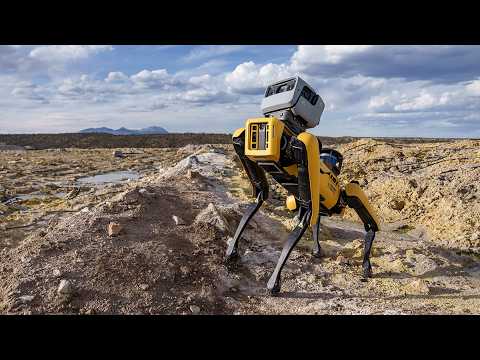
Spot is a four-legged mobile robot designed to move, sense, and collect data in real-world environments.
Its four-legged design gives it a significant advantage over wheeled robots in environments with:
- Stairs
- Uneven floors
- Grates
- Construction debris
- Narrow pathways
- Thresholds
- Sloped surfaces
- Industrial obstacles
A wheeled robot can be extremely efficient on a flat floor.
But many real facilities are not flat.
Factories contain stairs and platforms.
Construction sites change constantly.
Energy facilities can contain pipes, equipment, walkways, and uneven terrain.
Infrastructure may extend through spaces that were never designed for robots.
Spot's legs allow it to handle these environments while carrying specialized sensing equipment.
The result is a robot that can act as a mobile data-collection platform.
Why Spot Matters
The most important thing about Spot is not that it looks like a dog.
It is that Boston Dynamics has turned quadrupedal mobility into a commercial robotics platform.
Spot can be configured with different sensors and software depending on the customer's needs.
This changes the way the robot should be understood.
Spot is not one fixed robot performing one task.
Mobile robot + sensors + autonomy + software + enterprise workflow
The physical robot provides mobility.
The payload provides sensing.
The software provides autonomy.
Orbit provides fleet and data management.
Together, these components form a robotics system rather than simply a robot.
From Robot IconDog to Industrial Tool
Spot became famous through videos showing Boston Dynamics' robots walking, climbing, dancing, and navigating difficult terrain.
But the commercial version of Spot has a much more practical purpose.
Its job is often surprisingly simple:
- Go somewhere.
- Look at something.
- Measure something.
- Record what happened.
- Bring the information back.
That sounds straightforward.
The difficult part is doing it repeatedly and autonomously in environments that change over time.
For industrial organizations, that can have significant value.
A human technician might need to physically walk through a facility several times every day to check equipment.
Spot can potentially perform some of those rounds automatically.
Dynamic Sensing
Boston Dynamics describes Spot as a dynamic sensing platform.
This means the robot itself is not necessarily the primary source of value.
The sensors it carries are.
Spot can be equipped with different payloads for tasks such as:
- Visual inspection
- Thermal inspection
- Acoustic monitoring
- Laser scanning
- 3D mapping
- Gas detection
- Communications
- Research instrumentation
The robot provides the mobility required to bring those sensors to locations that may otherwise be difficult to reach.
This creates a powerful division of labor:
- Spot handles mobility.
- Payloads handle sensing.
- Software handles interpretation.
- Humans make decisions.
360-Degree Terrain Awareness
Spot's terrain-sensing system provides a 360-degree horizontal field of view with a listed range of approximately 4 meters.
This allows the robot to understand its immediate surroundings while navigating.
The system supports:
- Obstacle detection
- Terrain understanding
- Collision avoidance
- Autonomous navigation
Boston Dynamics says Spot can dynamically replan around new obstacles and can recover itself if it falls.
That capability is particularly important for autonomous inspection.
A robot following a route in a real facility cannot assume that the environment will remain exactly the same every day.
- Equipment may be moved.
- People may be present.
- Objects may be left in walkways.
- Temporary barriers may appear.
Spot needs to adapt rather than simply follow a rigid sequence of movements.
Four-Legged Mobility
Spot's most fundamental technological advantage is its locomotion.
The current system has a listed maximum speed of 1.6 m/s, can handle slopes of up to approximately ±30 degrees, and can step over obstacles up to 300 mm high.
These numbers are more meaningful when considered together.
A robot operating in an industrial facility does not necessarily need to move extremely fast.
It needs to:
- Stay stable
- Cross uneven terrain
- Climb and descend
- Navigate around obstacles
- Recover from disturbances
- Carry equipment
- Reach repeatable inspection positions
Spot's locomotion system is designed around those requirements.
Why Legs Instead of Wheels?
The choice of legs is not primarily about making Spot look more natural.
It is about mobility in environments that wheels struggle with.
Consider a construction site.
A wheeled robot may encounter:
- A small step
- A gap
- Loose material
- Uneven concrete
- A temporary obstruction
For a legged robot, these conditions can be handled through foot placement and body motion.
This is one reason quadruped robots are attractive for inspection and remote operations.
They can potentially operate in places where conventional autonomous mobile robots would require additional infrastructure.
Self-Righting
One of Spot's notable capabilities is its ability to self-right after falling.
Boston Dynamics specifically lists self-righting as part of Spot's autonomous capabilities.
This is important for commercial deployment.
A robot that requires a human to physically recover it every time it falls is difficult to operate autonomously.
Self-righting improves resilience.
It also demonstrates one of the advantages of legged robotics:
The robot can actively manipulate its body to recover from an abnormal position.
Autonomous Charging
Spot can also operate with autonomous charging workflows.
Boston Dynamics describes Spot as capable of autonomous charging as part of its broader autonomous operation.
This creates a more complete operational cycle:
Mission → Inspection → Return → Recharge → Next Mission
Without autonomous charging, a robot may still require regular human intervention.
With charging integrated into the workflow, Spot can become a more persistent member of an inspection operation.
90-Minute Average Runtime
Spot has a 564 Wh battery and a listed average runtime of approximately 90 minutes. Recharge time is listed at around 60 minutes.
This should not be interpreted as a fixed operating time for every deployment.
Actual runtime depends on:
- Payload
- Terrain
- Movement
- Environmental conditions
- Computing load
- Mission profile
For inspection work, however, the robot does not necessarily need to operate continuously.
A typical workflow might look like:
Scheduled inspection → 30-minute mission → Return to dock → Recharge → Wait for next mission
This makes battery capacity less restrictive than it might be for a robot expected to perform continuous physical labor.
14-Kilogram Payload Capacity
Spot can carry up to 14 kg / 30.9 lb of payload according to Boston Dynamics' current specifications.
This is one of the most important features of the platform.
The robot does not have to remain a camera-equipped machine.
It can carry specialized equipment such as:
- LiDAR
- Thermal cameras
- Acoustic sensors
- Gas sensors
- Radio equipment
- Computing hardware
- Scientific instruments
The payload system effectively turns Spot into a configurable mobile robotics platform.
The Spot Payload Ecosystem
Boston Dynamics provides a standardized payload interface that supports additional sensors, communications hardware, and computing equipment.
The current specification lists:
- M5 T-slot mounting rails
- Two DB25 connectors
- Up to 150 W per connector
- Software API support
This makes Spot attractive not only to companies purchasing a finished solution, but also to organizations that want to build their own robotics applications.
The robot becomes a platform rather than a closed appliance.
Spot Arm
Spot can also be equipped with the Spot Arm.
The arm adds physical manipulation capability to the quadruped platform, allowing Spot to interact with objects rather than simply observe them. Boston Dynamics describes the arm as an extension that allows Spot to physically manipulate objects around it.
This significantly expands the robot's potential.
Without an arm:
See → Measure → Report
With an arm:
See → Decide → Manipulate → Report
Potential tasks can include:
- Opening doors
- Moving objects
- Operating controls
- Manipulating equipment
- Collecting physical samples
- Performing research experiments
The combination of quadrupedal mobility and a robotic arm makes Spot a particularly flexible platform.
Spot as a Remote Operator
One of the more interesting applications for Spot is remote investigation.
Instead of sending a person into a potentially hazardous environment, an operator can send Spot.
The robot can provide:
- Video
- Thermal information
- Audio
- Spatial information
- Other sensor data
The human remains responsible for interpretation and decision-making.
Spot effectively becomes a remote physical presence.
This can be particularly valuable when the environment involves:
- Fire
- Chemical hazards
- Radiation
- Industrial equipment
- Structural uncertainty
- Other safety risks
Industrial Inspection
Industrial inspection is arguably Spot's most important commercial application.
Factories contain thousands of pieces of equipment.
Many need to be checked regularly.
Examples include:
- Pumps
- Motors
- Valves
- Pipes
- Gauges
- Electrical equipment
- Mechanical systems
A human technician can inspect these systems.
But repetitive inspection rounds consume time and may expose people to hazards.
Spot can automate portions of these rounds.
Predictive Maintenance
Spot can contribute to predictive maintenance by collecting recurring data.
Imagine a pump inspected every day.
- On Monday: Normal
- On Tuesday: Normal
- On Wednesday: Slight temperature increase
- On Thursday: Abnormal acoustic signature
- On Friday: Significant deviation
A human may not notice a gradual change during occasional manual inspections.
A robot can collect structured data at regular intervals.
This allows maintenance teams to compare measurements over time.
The value of Spot therefore comes not only from detecting today's problem.
It can also help identify trends before failures occur.
Boston Dynamics specifically positions Spot for autonomous inspections that can support predictive maintenance programs.
Thermal Inspection
A thermal camera mounted on Spot can identify temperature anomalies that are invisible to ordinary cameras.
Potential applications include:
- Electrical equipment
- Motors
- Pumps
- Transformers
- Industrial machinery
- Process equipment
A thermal inspection can reveal abnormal heat patterns before visible damage occurs.
Spot's mobility allows the thermal sensor to move from one inspection point to another automatically.
Acoustic Inspection
Spot can also serve as a mobile acoustic sensing platform.
This is useful for identifying anomalies such as:
- Air leaks
- Unusual mechanical sounds
- Equipment noise
- Changes in operating conditions
Again, the robot is not necessarily "solving" the problem itself.
Its role is to collect consistent data.
The human maintenance team can then decide what action is required.
Digital Twins and 3D Scanning
Spot can carry laser-scanning and other mapping payloads to capture information about physical environments.
This enables applications such as:
- 3D site documentation
- Facility mapping
- Construction monitoring
- As-built comparison
- Digital twin creation
This is particularly useful in construction.
A site changes every day.
Instead of relying entirely on manual documentation, a robot can repeatedly capture spatial information.
The resulting data can then be compared over time.
Construction Sites
Construction is one of the environments where Spot's mobility becomes especially valuable.
Construction sites are constantly changing.
There may be:
- Scaffolding
- Rebar
- Uneven surfaces
- Temporary structures
- Narrow passages
- Debris
- Changing floor layouts
Boston Dynamics lists construction as a major Spot application, including progress monitoring, digital twins, and comparison of as-built conditions.
Spot can walk through the site while collecting data.
That creates a repeatable digital record of physical progress.
Energy and Natural Resources
Energy facilities are another strong application.
Spot can be used for inspections in environments involving:
- Oil and gas
- Utilities
- Power generation
- Mining
- Remote facilities
Boston Dynamics says Spot can perform operator rounds and inspections in energized, radioactive, or otherwise hazardous areas.
The key benefit is not simply automation.
It is risk reduction.
If a robot can collect the necessary information before a person enters the area, the human team's exposure can potentially be reduced.
Government and Public Safety
Spot can also be configured for government and public-safety applications.
Potential use cases include:
- Remote investigation
- Hazard assessment
- Situational awareness
- Emergency response
- Explosive-ordnance environments
- Hazardous-material environments
The idea is simple:
Send the robot first.
Instead of immediately sending personnel into an uncertain environment, Spot can provide an initial view of the situation.
That can help human operators decide what should happen next.
Research and Education
Spot is also valuable as a research platform.
Universities and research organizations can use the robot to investigate:
- Legged locomotion
- Robot perception
- Navigation
- Manipulation
- Computer vision
- Autonomous systems
- Human-robot interaction
- Machine learning
Boston Dynamics explicitly positions Spot as a flexible platform for research and education.
This is important because the same hardware can be used for very different experiments.
Researchers do not necessarily need to build the entire robot themselves.
They can focus on the problem they actually want to study.
Spot SDK and APIs
Spot is designed to be programmable.
Boston Dynamics provides development documentation and a software API for building applications and payload integrations.
This allows developers to work with the robot at a deeper level.
Instead of simply pressing:
Start Mission
developers can build custom systems around Spot.
This could involve:
- Custom navigation
- Custom perception
- Sensor integration
- Data collection
- Robot control
- Research algorithms
- Automated workflows
For a robotics platform, this extensibility is extremely important.
Orbit: Managing Spot at IconScale
A single robot can be managed manually.
A fleet is a different problem.
This is where Orbit becomes important.
Boston Dynamics describes Orbit as a unified ecosystem for managing facilities, Spot fleets, and industrial inspections. It provides visibility into robot and equipment health and allows users to access robots remotely.
The architecture becomes:
- Spot → Physical data collection
- Orbit → Fleet and inspection management
- Enterprise systems → Business decisions
This is what turns individual robots into an operational robotics system.
One Spot or Hundreds?
Spot is designed to scale from individual deployments to fleets.
Boston Dynamics says its enterprise solution supports operating a single Spot or an entire fleet, including remote operation over significant distances.
For large industrial organizations, this matters.
A company might eventually have:
- One Spot at a pilot facility
- Several robots across one site
- A fleet across multiple facilities
The software layer becomes increasingly important as deployment expands.
Reliability Is the Product
For a research robot, impressive demonstrations are valuable.
For an industrial robot, reliability is more important.
A robot used for inspection must be able to:
- Start its mission
- Navigate the route
- Avoid obstacles
- Collect the required data
- Return safely
- Recharge
- IconRepeat the process
Again and again.
Boston Dynamics says Spot has undergone extensive testing in laboratory and field environments and emphasizes autonomous charging, dynamic replanning, and self-righting.
This focus on repeatability is one of the most important distinctions between Spot and many experimental quadrupeds.
IP54 Protection
Spot has an IP54 ingress protection rating.
The current specification also lists an operating temperature range of -20°C to 55°C.
This makes the robot suitable for a broad range of industrial environments.
However, IP54 should not be interpreted as making Spot waterproof or suitable for unrestricted outdoor exposure.
Deployment conditions still need to be evaluated for each environment and payload.
Strengths & Limitations
Strengths
Proven Commercial Platform
Spot is not merely a research prototype. Boston Dynamics says more than 1,500 robots are already in customer hands.
Excellent Mobility
Its quadrupedal architecture allows it to handle stairs, slopes, obstacles, and uneven environments.
Strong Payload Flexibility
The 14 kg payload capacity allows organizations to mount specialized sensors and computing equipment.
Broad Application Range
The same platform can be used in manufacturing, energy, construction, government, and research.
Autonomous Operation
Spot can navigate, replan, self-right, and recharge with limited intervention.
Large Software Ecosystem
APIs, payload integrations, and Orbit make Spot more than a standalone robot.
Remote Inspection
The robot can investigate areas that may be inconvenient or hazardous for people.
Repeatable Data Collection
Autonomous inspection routes can generate structured data over time.
Limitations
Limited Runtime
The current average runtime is approximately 90 minutes, with actual runtime depending on payload and environmental conditions.
Not a General-Purpose Humanoid
Spot is not designed to use ordinary human tools or workstations in the same way a humanoid can.
Limited Manipulation Without the Arm
The base robot is primarily a sensing and mobility platform. Physical interaction requires additional hardware such as the Spot Arm.
Payload Capacity Is Not Heavy-Lift Capacity
The 14 kg payload rating is suitable for sensors and equipment but is not comparable with heavy industrial lifting robots.
Enterprise Cost and Complexity
Spot is an enterprise robotics system rather than a consumer gadget. Deployment can involve sensors, software, networking, integration, training, and maintenance.
Data Still Requires Interpretation
Spot can collect enormous amounts of information, but organizations still need software and human expertise to determine what the data means.
Who Is Spot For?
Spot is best suited to organizations where physical access, inspection, and recurring data collection have meaningful operational value.
Manufacturing
For:
- Equipment inspection
- Predictive maintenance
- Digital twins
- Production monitoring
Energy
For:
- Remote facility inspection
- Operator rounds
- Thermal monitoring
- Hazardous-area assessment
Construction
For:
- Site documentation
- Progress monitoring
- 3D scanning
- As-built comparison
Government and Public Safety
For:
- Remote investigation
- Hazard assessment
- Emergency response
- High-risk environments
Academia
For:
- Robotics research
- AI research
- Navigation
- Perception
- Manipulation
What Makes Spot Different?
There are now many quadruped robots on the market.
So why does Spot remain important?
The answer is not simply locomotion.
Many modern quadrupeds can walk.
The real differentiation is the complete system around the robot.
Spot combines:
- Mobility
- Sensors
- Autonomy
- Payload integration
- APIs
- Fleet management
- Enterprise support
- Real-world deployment
That combination is much harder to reproduce than the physical robot alone.
Spot as a Robotics Platform
Perhaps the best way to understand Spot is not as a "robot dog."
It is a robotics platform with legs.
The physical body is only the foundation.
A customer can build different versions of Spot for different missions.
One robot might carry:
Thermal camera
Another:
LiDAR
Another:
Acoustic sensor
Another:
Gas detection system
Another:
Spot Arm
Another:
Research equipment
This modularity significantly extends the useful life of the platform.
The robot can evolve as the customer's needs change.
The Real Value: Data
Spot's most valuable output is often not physical movement.
It is data.
A robot can repeatedly collect information about a facility:
- Temperature
- Images
- Sound
- 3D geometry
- Equipment state
- Environmental changes
Over time, these measurements become a historical record.
That allows organizations to move from:
"Someone inspected this machine."
to:
"We have months of structured information about this machine."
That is a much more powerful foundation for predictive maintenance and operational intelligence.
From Robot to Digital Workforce
Spot also represents an important transition in robotics.
Traditional robots automate physical actions.
Spot can automate physical observation.
This distinction is increasingly important.
Many industrial jobs involve not only moving things, but also:
- Looking
- Checking
- Measuring
- Recording
- Comparing
- Reporting
These activities are difficult to automate with traditional fixed robots.
A mobile robot changes the equation.
Instead of bringing the object to the robot:
Bring the robot to the object.
That is one of Spot's most important ideas.
Our Take
Spot is arguably one of the most commercially significant quadruped robots ever developed.
Not because it is the fastest.
Not because it carries the largest payload.
And not because it is the most visually impressive robot dog.
Its significance comes from something much more practical:
Spot works as a system.
The robot can move through difficult environments.
Its sensors can collect information.
Its autonomy can repeat missions.
Its payload architecture can adapt to new applications.
Its APIs allow developers to build on top of it.
And Orbit provides an enterprise layer for managing fleets and inspection workflows.
This makes Spot fundamentally different from many robotics demonstrations.
A robot that performs an impressive movement once is interesting.
A robot that performs the same inspection route every day for months can become economically valuable.
That is the real significance of Spot.
The Bottom Line
Boston Dynamics Spot is a commercial quadruped robot designed to extend human capabilities through autonomous mobility, sensing, and inspection.
Its current specifications include a 33.8 kg body, 1.6 m/s maximum speed, ±30° slope capability, 300 mm step height, 14 kg payload capacity, 90-minute average runtime, 360° terrain sensing, and IP54 protection.
But specifications alone do not explain Spot's success.
Its real strength is the ecosystem surrounding the robot.
- Spot provides mobility.
- Payloads provide specialized sensing.
- The Spot Arm provides manipulation.
- APIs provide programmability.
- Orbit provides fleet management.
- Enterprise support turns the technology into an operational system.
This is why Spot remains highly relevant even as a new generation of humanoid robots enters the market.
Humanoids are trying to bring robots into human workflows.
Spot takes a different approach:
Go where humans cannot easily go.Collect information humans cannot continuously collect.Keep people away from unnecessary danger.Turn physical environments into data.
That makes Spot less of a futuristic "robot dog" and more of a practical mobile robotics workforce for inspection and sensing.
Best for
Industrial inspection, predictive maintenance, energy facilities, construction, infrastructure monitoring, hazardous-area investigation, research, and autonomous data collection.
Key differentiator
A mature quadruped platform that combines agile mobility, autonomous inspection, modular payloads, programmable APIs, and enterprise fleet management.
Product category
Commercial quadruped / mobile inspection robot.
Core value proposition
Go there. Sense it. Record it. IconRepeat it.
Spot at a Glance
| Specification | Spot |
|---|---|
| Robot type | Quadruped mobile robot |
| Developer | Boston Dynamics |
| Primary role | Inspection, sensing, data collection |
| Weight with battery | 33.8 kg / 74.5 lb |
| Maximum speed | 1.6 m/s |
| Maximum slope | ±30° |
| Maximum step height | 300 mm / 11.8 in |
| Terrain sensing field of view | 360° |
| Terrain sensing range | 4 m / 13 ft |
| Average runtime | 90 minutes |
| Standby time | 180 minutes |
| Recharge time | 60 minutes |
| IconBattery capacity | 564 Wh |
| Payload capacity | 14 kg / 30.9 lb |
| Ingress protection | IP54 |
| Operating temperature | -20°C to 55°C |
| Connectivity | Wi-Fi, Ethernet |
| Payload interface | M5 T-slot rails |
| Payload connectors | 2 × DB25 |
| Payload power | Up to 150 W per port |
| Robot API | Available |
| Fleet management | Orbit |
| Optional manipulation | Spot Arm |
Specifications are based on Boston Dynamics' current Spot product information. Runtime can vary depending on payloads and environmental conditions.